A low speed crash can look minor at first, yet the physical and financial consequences are not always obvious in the first hours or days. In Charlotte, North Carolina, someone may leave a parking lot collision, intersection bump, or stop and go traffic crash believing the matter will be simple, only to notice increasing neck […]
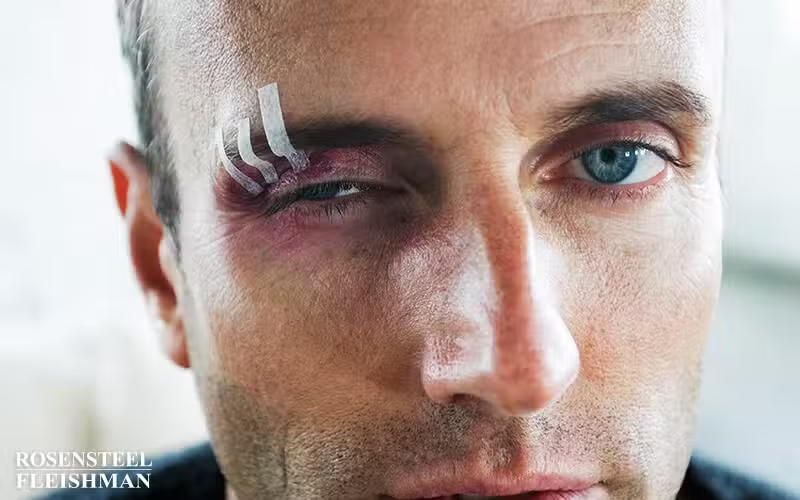

An injury at a bar or nightclub may involve several people and organizations, but presence at the property or a connection to alcohol does not establish responsibility by itself.
Begin with the conduct that allegedly caused harm, the person who acted, the entity that controlled the relevant decision or location, the information available before the event, and the records connecting each proposed party to a legal theory.
Identify every role before assigning a theory
- Person alleged to have struck, pushed, threatened, restrained, ejected, served, transported, supervised, or failed to act
- Permittee, bar or restaurant operator, tenant, property owner, hotel, event organizer, promoter, management company, employer, and insurer
- Employee, manager, bartender, server, host, security employee, outside security contractor, off-duty officer, vendor, and person directing the work
- Area controlled by each entity, including entrance, interior room, patio, restroom, hallway, elevator, parking area, sidewalk, or adjoining property
- Contract, lease, permit, policy, schedule, invoice, assignment, communication, or witness account supporting each claimed relationship
The person who caused the contact is a separate starting point
A deliberate strike or other contact can present intentional-tort questions that differ from a negligence theory against a business. Record the sequence, words and conduct attributed to each participant, claimed consent or self-defense, use of an object, relative positions, intervention, departure, injury mechanism, and source for every account. An arrest, charge, dismissal, or criminal disposition does not automatically decide a separate civil claim.
Insurance and collectability are also separate from responsibility. Do not redirect the analysis to a business merely because an individual may lack an apparent insurance policy or assets.
Premises and security theories require control, notice, and foreseeability evidence
In Cassell v. Collins, reported in volume 344 of the North Carolina Reports, the Supreme Court discussed the general rule concerning independent criminal acts and circumstances in which a landowner-duty question may arise. The opinion described Foster v. Winston-Salem Joint Venture, where evidence of numerous prior parking-lot incidents supported a foreseeability issue.
That framework does not make every prior event equivalent or require a fixed staffing level. A review should compare type, location, timing, frequency, severity, similarity, notice, control, and the response available before the incident.
- Earlier threats, disputes, ejections, assaults, police calls, incident reports, complaints, trespass notices, and manager communications
- Staffing and security assignments, entrances, screening, cameras, lighting, patrol, communication, intervention authority, police-request procedure, and emergency response
- What the responsible decision-maker knew, when it was known, what action followed, and whether the alleged omission relates to the injury sequence
- Policies and industry material treated as evidence that may require foundation and context, not as an automatic legal standard
Alcohol service is a distinct path
G.S. 18B-305(a) makes it unlawful for a permittee, the permittee’s employee, or an ABC store employee to knowingly sell or give alcoholic beverages to a person who is intoxicated. The statute does not establish that every drink, visible behavior, altercation, injury, or ABC proceeding produces civil liability.
In Davis v. Hulsing Hotels N.C., Inc., 246 N.C. App. 406 (2016), the Court of Appeals evaluated allegations that hotel employees continued serving an intoxicated adult who later died from alcohol poisoning. At the pleading stage, the court held that the complaint sufficiently stated a negligence-per-se claim under G.S. 18B-305. The ruling depended on the alleged service, knowledge, protected harm, causation, and procedural posture; it does not decide a different bar-fight record.
- Permittee and server identity, itemized checks, point-of-sale times, tabs, receipts, drink tickets, payment records, video, and witness observations
- What was served, by whom, when, and what the server or permittee employee allegedly observed before each disputed service
- Speech, balance, coordination, conduct, statements, refusal, removal, food or water, transportation discussion, and later observations attributed to their sources
- Connection between the disputed service, the later conduct or medical event, the claimed injury, and possible alternative causes
Employment and contracting relationships must be proved separately
A uniform, radio, work location, or instruction from a manager can identify evidence but may not establish the legal relationship by itself. Preserve hiring and assignment records, contracts, schedules, pay records, supervision, policies, authority to control the work, incident reporting, and communications. Direct negligence, vicarious liability, independent-contractor issues, and corporate participation should not be merged into one allegation.
Keep claimant conduct and causation fact specific
North Carolina defenses can make the conduct of every participant important. Preserve initiation, escalation, warning, withdrawal, opportunity to avoid contact, impairment evidence, statements, video, physical evidence, and conflicting accounts. Do not assume that presence in a bar, consumption of alcohol, mutual words, or participation in part of an encounter automatically determines contributory negligence or damages.
Use the related guide for the evidence request
The related guide to alcohol-service and security records after a North Carolina bar altercation covers participant mapping, point-of-sale material, video, security records, preservation, and witness foundations.
Rosensteel Fleishman Car Accident & Injury Lawyers provides general information about discussing a North Carolina personal-injury matter arising from a bar or nightclub incident. Parties, control, notice, evidence, legal theories, defenses, insurance, causation, damages, and deadlines depend on the specific record.
Sources
Additional Personal Injury Articles
Lane Splitting Accident Considerations for Riders in Charlotte North Carolina
In Charlotte, North Carolina, a motorcycle crash involving movement between lanes can quickly raise questions about visibility, road position, and each driver’s actions. Those questions become even more complicated when an injured rider waits to seek medical care, since an insurance company may examine both the circumstances of the collision and the timing of the […]
How Witness Statements Support an Injury Claim After a Serious Accident
After a serious accident, the people who saw what happened can become an important source of information about the events surrounding an injury. A witness may remember the position of the vehicles, a traffic signal, a driver's behavior, road conditions, or what an injured person said and did immediately afterward. In Charlotte, where crashes may […]
Map and Diagram of Accident Scene Evidence When Photos Are Incomplete
Accident recovery rarely follows a perfectly straight path, especially when early symptoms change or new limitations appear after a person returns to normal routines. In Charlotte, someone injured in a collision may begin with goals such as reducing pain, restoring movement, returning to work, or safely resuming everyday activities, then adjust those goals as doctors […]