Can an injury claim still move forward when recovery takes longer than expected? For many people in Charlotte, the answer depends on how carefully the situation is documented, how treatment progresses, and whether the available resolution options match what is actually happening in real life. After a car accident, early assumptions about healing can change. […]
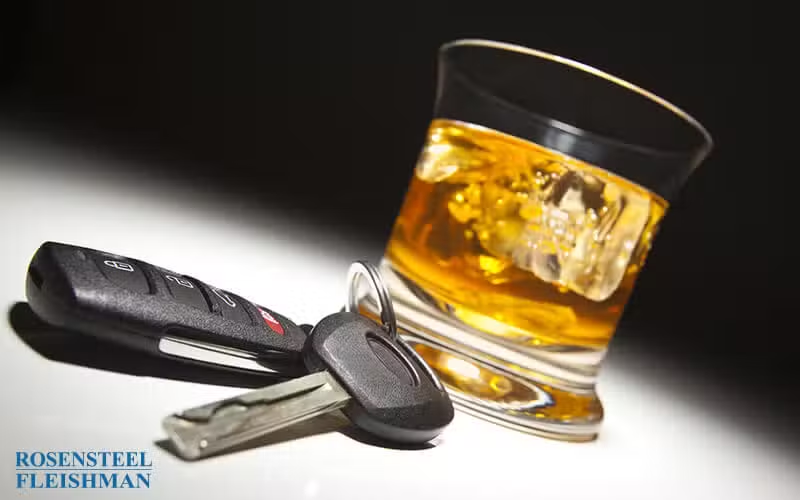

On Friday, a jury found a Raleigh couple not guilty of aiding and abetting underage drinking, which led to a fatal car accident. The couple was hosting their daughter’s wedding at their house. Their son invited some of his friends to celebrate with the wedding guests. One of these friends left the house later that night and crashed his car into a tree about seven miles from the couple’s house. The blood alcohol level of the friend was approximately 2 ½ times the legal limit at the time of the accident. Officers estimate that the car was traveling approximately 89 miles per hour just prior to the accident. The friend did not survive the crash.
Evidence from the criminal trial showed that the mother of the bride attempted to make the friend stay at their home but he left the wedding party intoxicated. Texts between the friend and his own parents showed that he asked them to come pick him up at the wedding party, but prior to the parents arriving, he decided to get in his car and drive himself.
The wedding host couple’s own son was also charged with and pled guilty to underage purchase of alcohol. The son had bought a fifth of Jack Daniels, which the teens shared at the wedding party outside of the presence of the wedding hosts. At the couple’s trial, the evidence showed that the teens also drank wine at the wedding party but that the couple did not condone their drinking nor talk to the teens much during the wedding party.
In addition to the criminal charges, the couple is also facing a civil lawsuit. In North Carolina, a social host can be liable for injuries caused by a person when “he (1) served alcohol to a person (2) when he knew or should have known the person was intoxicated and (3) when he knew the person would be driving afterwards.” (Camalier v. Jeffries 1995) Typically, the debated issues in social host liability are whether the social host knew or should have known that the person was intoxicated and whether the social host knew that the person would be driving afterwards.
In a 2001 court of appeals case, Smith v. Winn-Dixie Charlotte, Inc., the court examined the second factor and noted that “[e]vidence the defendant knew or should have known a person was ‘noticeably intoxicated’ might include, but is not limited to, such outward signs of intoxication as slurred speech, lack of control over body motions, and an odor of alcohol.”
A 2003 court of appeals case, Swinton v. La Fogata, provided some analysis of the third factor. The court concluded that the plaintiff did meet their burden on the third element, stating that
The decedent was socializing with a group of at least ten people at the restaurant. Indeed, any member or members of the group could have been driving. Conversely, it is possible that the patrons intended to take a taxi, walk, or seek some other means of transportation to get home. In short, nothing put defendant on notice that [the decendent] was intoxicated and would be driving afterwards.
However, even if a plaintiff can prove all three factors for social host liability, there can be other hurdles to overcome, such as the plaintiff’s contributory negligence. Just last year, the North Carolina Court of Appeals issued an opinion in a case which involved the death of a 19-year-old who had been served alcohol at a cookout hosted by his grandparents. Later that night, the 19-year-old drove away from the house in his car, hit a tree and died. His blood alcohol content at the time of the accident was 0.17. The estate of the deceased grandson filed an action against the defendant grandparents under the theory of social host liability.
The court of appeals held that the superior court’s dismissal was proper because of the deceased’s contributory negligence. Under the doctrine of contributory negligence, the deceased was obligated to exercise the care of an ordinarily prudent person under the same or similar circumstances. If he failed to exercise such care and this failure proximately caused his injury, then he was contributorily negligent.
The court of appeals in Mohr relied on the North Carolina Supreme Court case Sorrells v. M.Y.B. Hospitality Ventures of Asheville (1992). In Sorrells, the driver was at a bar with friends and was seated at a table. He ordered from the waitress and consumed a shot of tequila. Thereafter, he tried several times to order another drink from the waitress but his friends advised that he was driving and should not be served. At that time, the driver was “highly intoxicated and showed visible signs of impairment.” The driver went to the bathroom and on his way back to the table, stopped at the bar and ordered another drink. The waitress told the manager that she had been advised not to serve the driver but the manager told the bartender to serve him. When the driver finished his drink, he ignored his friends’ offers to find another way home. Instead, he got in his car and ended up crashing his car and dying.
The Court in Sorrells reasoned that the plaintiff could not recover damages because “the allegation that decedent drove his vehicle while impaired established contributory negligence as a matter of law and therefore barred his recovery of damages.” The actions of the bar did not rise to the level of willful and wanton negligence, and instead were the same level of negligence as the driver.
The plaintiff in Mohr attempted to distinguish his case from Sorrells because Sorrells was based on the Dram Shop Act and Mohr is based on the common law theory of social host liability. The court of appeals rejected this distinction because “[t]he Supreme Court’s decision… expressly analyzed the plaintiff’s claims under common law negligence principles as well as under the Dram Shop Act.” Furthermore, the court of appeals noted that “Sorrells has been cited in subsequent cases involving claims based on common law negligence where decedents voluntarily consumed alcohol and were found to be contributorily negligent in causing their own deaths.”
If you have been injured in a car accident, contact a lawyer at Rosensteel Fleishman Car Accident & Injury Lawyers (704) 714-1450.
Additional Car Accidents Articles
How Soft Tissue Injuries Are Evaluated After a Crash Over Time
The way an injury feels right after a crash is not always the way it will feel several days later. Soft tissue injuries can be frustrating because soreness, stiffness, swelling, headaches, or limited movement may develop slowly, especially after a person has gone home, returned to work, or tried to resume a normal routine around […]
High Impact Crash Overview for Claims With Serious Damage
A serious crash can leave a family trying to make decisions before all the facts are clear. Vehicle damage, medical concerns, missed work, school pickup plans, and insurance calls can all arrive at the same time, which makes it easy for important details to get overlooked. A practical high impact crash overview can help explain […]
How Liability Is Determined in a Car Accident When Reports Are Delayed
Fault decisions often become harder when crash reports, medical records, repair estimates, or insurance updates are delayed. In a Charlotte car accident, even a few missing details can leave drivers unsure about what the insurance company is reviewing, why the claim is taking longer, and what happens when each side tells a different story. A […]



