
An article cannot determine whether cold therapy is appropriate for an individual injury. Clear records can help separate medical questions from practical losses and claim issues.
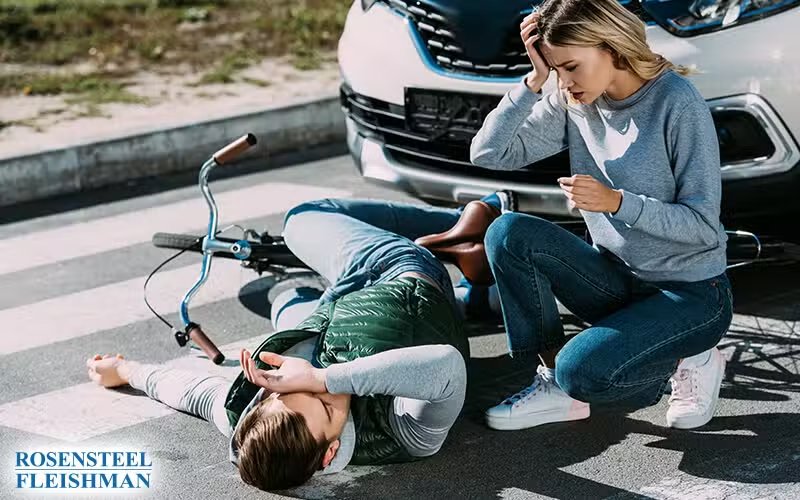

Bicycle accident reports often become important when the people involved remember the same collision differently. A driver may say a cyclist entered the roadway unexpectedly, while the cyclist may remember having the right of way and being visible well before impact. In Charlotte, those differences can influence how insurers and others evaluate responsibility, particularly when several people, vehicles, or roadway conditions contributed to what happened. Accident reports in bicycle cases can provide an early reference point for comparing these accounts with physical evidence, witness observations, diagrams, citations, and other information gathered after the crash.
A report does not automatically determine who was legally responsible, but it can help organize facts that might otherwise become difficult to sort out. Someone reviewing a serious bicycle collision may also benefit from discussing the documentation with a cyclist accident injury attorney, particularly when several competing explanations have emerged. Attorney Corey Rosensteel has noted that "small factual differences can matter when responsibility is disputed." Looking at those differences carefully can help explain why two versions of the same event may ultimately produce very different claim evaluations.
Article Brief
An accident report can provide a useful starting point for comparing conflicting accounts of a bicycle crash, but the report is usually only one part of the broader evidence. Statements, vehicle damage, bicycle damage, photographs, witnesses, traffic controls, weather conditions, medical records, and later investigation may all help clarify how responsibility should be distributed among the people or entities involved.
- Reports can preserve statements made close to the time of the crash.
- Diagrams and observations may help compare each person's description of movement and impact.
- A citation can be relevant without automatically resolving civil responsibility.
- Multiple parties may share responsibility depending on the evidence.
- Additional evidence can confirm, challenge, or add important context to the report.
How Reports Help Sort Out Competing Accounts
The difficulty with a disputed bicycle collision is rarely that there is no story about what happened. More often, there are several stories, each emphasizing different details. A cyclist may describe traveling straight through an intersection when a vehicle turned across the bike's path. The driver may say the cyclist was approaching too quickly to be seen. A passenger might remember the traffic signal differently, while a nearby witness may have observed only the final seconds before impact.
An accident report can bring those accounts into one document and identify points of agreement and disagreement. The responding officer may record where the vehicles were found, what each person said, whether there were visible skid marks or debris, and whether traffic controls were present. A diagram may indicate estimated directions of travel or the apparent area of impact. These details create a framework for evaluating the competing versions rather than relying on one person's memory alone.
Why Early Statements Can Carry Meaningful Context
Statements made shortly after a collision may be useful because they are often recorded before people have had much time to reconstruct the event repeatedly in their minds. That does not mean every early statement is perfectly accurate. A cyclist may be injured, frightened, or receiving emergency care. A driver may be shaken and unsure about distances, speeds, or timing.
The value often comes from comparison. If a driver's initial statement says the cyclist was visible before a turn began, but a later statement says the bicycle appeared without warning, that difference may deserve closer examination. Likewise, if the cyclist initially could not remember the color of a traffic signal but later expresses certainty, other evidence may become particularly important.
Consistency can strengthen an account, but inconsistency does not automatically mean someone is being dishonest. Human memory is imperfect, especially after a sudden and stressful event. The practical question is whether photographs, video, witness statements, physical damage, electronic records, or roadway evidence help explain which version fits the available facts.
How Physical Evidence Can Support or Challenge a Report
The report itself may contain observations about the bicycle, motor vehicle, roadway, and surrounding area. Those observations can be compared with photographs and other evidence collected later. Damage to the side of a vehicle, for example, may tell a different story than damage concentrated on the front bumper. The location of a damaged bicycle or scattered debris may also provide context about where the impact occurred.
Consider a Charlotte cyclist traveling through an intersection on a rainy evening. The driver says the cyclist suddenly entered the lane, while the cyclist says the vehicle turned across an established path of travel. Wet pavement, reduced visibility, street lighting, reflective clothing, traffic signals, and the location of the impact could all matter. Seasonal rain or fading daylight may help explain visibility conditions without necessarily excusing either person's actions.
This is why the report should usually be read alongside the evidence rather than in isolation. An officer may arrive after vehicles have moved or after witnesses have left. Road conditions may change quickly. Rain can wash away marks on the pavement, and damaged bicycles are sometimes moved for safety before photographs are taken. The report captures an important moment, but it may not capture everything.
Responsibility Can Be More Complicated Than One Driver and One Cyclist
Some bicycle cases involve more than two participants. One driver may force another vehicle into a cyclist's path. A delivery vehicle may block sight lines near an intersection. Road construction could affect lane positioning. A property owner or contractor may have created a visibility problem near an entrance. In other situations, several drivers may each have contributed to a chain of events.
When more than one person may share responsibility, the accident report can help identify vehicles, witnesses, insurance information, roadway features, and initial allegations. That information can be valuable when investigators later try to reconstruct how the collision unfolded.
Responsibility may also depend on conduct that is not obvious from the report alone. Phone records, vehicle data, nearby surveillance footage, dashcam video, bicycle computer information, and witness interviews can sometimes add information about speed, timing, distraction, or movement. A report might identify the participants, while later investigation explains their respective roles more clearly.
For an injured cyclist, these distinctions can have practical financial consequences. If responsibility is heavily disputed, an insurer may challenge whether medical expenses, lost income, bicycle damage, or other losses should be paid. Reviewing the report alongside the broader evidence with a bike accident attorney can help a person understand why a claim is being evaluated a certain way and what additional documentation may be relevant.
Practical Steps When the Report Does Not Tell the Whole Story
People sometimes become discouraged when they read an accident report and believe it does not accurately describe what happened. A diagram may seem incomplete, a statement may be shortened, or an important witness may not appear anywhere in the document. Those concerns are understandable because the report can feel official, but it is important to remember what the document represents. It generally reflects information available to the responding officer at a particular point in time.
Additional evidence can provide a fuller picture. Photographs taken at the scene may show lane markings, damage, lighting, construction, or obstructions that are difficult to describe in a short report. Medical records may also help establish that an injured cyclist was not in a position to provide a detailed statement immediately. Witnesses who left before police completed the report may later provide useful information about the moments before impact.
Preserve Information That Can Help Reconstruct the Collision
Useful documentation is often easiest to obtain early. Photographs may disappear from a phone, nearby businesses may overwrite surveillance recordings, and witnesses can become harder to locate. Keeping the accident report together with photographs, medical paperwork, repair estimates, damaged equipment information, and insurance correspondence can make later review much easier.
It can also help to write down what you remember without trying to make the memory sound more certain than it actually is. Details such as travel direction, traffic signals, weather, visibility, vehicle movement, and what happened immediately before impact may be useful. If there are details you genuinely do not remember, noting that uncertainty can be more reliable than trying to fill in missing pieces.
Look at the Entire Record Before Drawing Conclusions
A single sentence in a police report should not necessarily be treated as the final word on a bicycle accident. The better approach is usually to compare the report with the complete record and identify where the evidence agrees, where it conflicts, and where important questions remain unanswered. Attorney Corey Rosensteel has observed that "the full picture often comes from comparing several sources of evidence." That comparison is particularly important when responsibility may be divided among several participants.
Rosensteel Fleishman can review bicycle accident documentation and discuss how conflicting evidence may affect a claim. People who want to ask questions about their circumstances can reach the firm at 1-704-714-1450. A conversation can be useful when the report contains an unfamiliar conclusion, leaves out significant information, or conflicts with photographs, witnesses, or other evidence.
The practical takeaway is to treat the accident report as an important piece of the factual record rather than the entire record. Preserving other evidence, documenting injuries and expenses, identifying witnesses, and reviewing inconsistencies early can make it easier to understand how responsibility may ultimately be evaluated.
Additional Bicycle Accidents Articles
Vocational Rehabilitation Costs and Lost Earnings After a Bicycle Injury
Work disruptions after a bicycle injury can involve more than missed paychecks. Separating employment support expenses, lost income, and future earning concerns helps make the financial picture clearer.
How Insurers Evaluate Extra Work Breaks During Bicycle Injury Recovery
Extra breaks can change a workday without changing a paycheck. Clear records help distinguish interrupted tasks, unpaid time, and questions about responsibility for a bicycle accident.
Charlotte Street Lighting and Light Sensitivity After a Bicycle Injury
Street lighting at a crash scene and light sensitivity afterward raise different documentation questions. Clear records can help explain what happened, what changed, and what still needs legal review.



