
Families often think about crash safety in terms of seat belts, airbags, and where children are seated, but unusual seating positions can change how those protections work. A passenger who is reclined far back, leaning toward the center console, resting their feet on the dashboard, or sitting at an angle may not interact with a […]
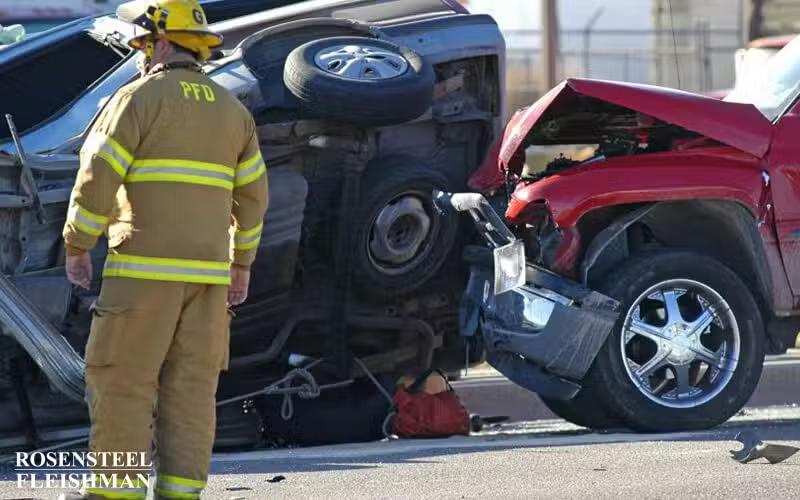

An animal collision can develop into more than one crash. A driver may strike a deer or another animal, stop in or near a travel lane, and then be hit by an approaching vehicle. Passengers, occupants who exit, or people who stop to assist may face additional danger. Each stage requires its own timeline and evidence rather than one general conclusion about an “animal accident.”
An animal strike and a later collision with the disabled vehicle are separate events that require separate timelines, duties, and causal findings.
Separate the event into stages
- Animal encounter: when the animal became visible, lane and direction of travel, speed, braking, steering, impact, and any earlier opportunity to reduce the risk
- Vehicle disablement: where the vehicle stopped, whether it could move, lighting and warning devices, damage, road geometry, shoulder condition, and traffic conditions
- Occupant movement: when each person exited, where each person moved, why movement occurred, what warnings were available, and what hazards were visible
- Approaching traffic: perception distance, speed, lane position, sight lines, following traffic, braking, steering, and available avoidance
- Later impact and response: collision sequence, injuries, assistance, 911 and dispatch timing, emergency placement, vehicle movement, and changes to the scene
Safety guidance and civil fault are different questions
The North Carolina Department of Transportation’s guidance for avoiding collisions with deer advises drivers not to swerve, to move a vehicle off the road if possible after a collision, and to call 911. The guidance is useful for prevention and immediate safety. It does not by itself establish negligence, contributory negligence, or causation in a civil claim.
Wildlife behavior can be unpredictable, and the safest response depends on the surrounding vehicles, speed, shoulder, visibility, and available space. Evidence should show what was reasonably perceptible and possible at each moment rather than assuming that every driver should brake, swerve, or stay in the lane in the same way.
North Carolina regulates stopped vehicles on highways
G.S. 20-161 contains rules for stopping, parking, or leaving a vehicle on the highway and distinguishes highways by posted speed. The disabled-vehicle exceptions in subsections (a) and (a1) require disability so extensive that stopping and temporarily leaving the vehicle on the specified portion of the highway is impossible to avoid. The complete subsection, road type, speed limit, vehicle condition, available shoulder, and visibility must be matched to the event.
- Determine whether the vehicle was operable after the animal strike and what movement could occur without creating a greater danger
- Measure lane and shoulder width, grade, curve, lighting, weather, sight distance, traffic volume, and visibility from approaching drivers’ positions
- Identify headlights, hazard lights, brake lights, emergency lighting, flares, reflective material, people signaling, and when each warning began
- Preserve the disabled vehicle, damaged lighting, electrical state, diagnostic and event data, tire and steering condition, and post-collision movement
- Separate a statutory question from ordinary care and from proof that a particular act caused the later impact
Post-crash duties depend on injury and vehicle condition
G.S. 20-166 addresses stopping, remaining at the scene, providing identifying information, rendering reasonable assistance, and certain movement of a drivable vehicle after a crash without injury or death. The statute contains distinct provisions and exceptions. A person should not be told simply to move or not move a vehicle without accounting for injury, drivability, immediate danger, and the current statutory text.
People who stop to help also create a separate factual record. Their arrival time, purpose, vehicle and body position, visibility, warnings, first-aid activity, and relationship to the later impact matter. The statute includes a limited provision concerning civil liability for first aid or emergency assistance, subject to its terms; it is not a blanket rule for every action at a crash scene.
Evaluate the approaching driver without hindsight
- Original vehicle, dash-camera, surveillance, phone, telematics, event-data, dispatch, and 911 files with timestamps
- Headlight reach, contrast, glare, grade, curve, obstructions, lane markings, traffic, weather, road surface, and comparable-time photographs
- Speed range, perception point, response interval, braking and steering path, following distance, lane options, and collision-avoidance technology
- Witness locations and statements in original form, including when the disabled vehicle, animal, occupants, helpers, or warnings first became visible
- Alternative causal sequences that test both the initial animal encounter and the later collision without treating either account as established
A sudden-emergency claim requires its own proof
An animal entering the roadway may support an asserted emergency, but the label is not enough. The related guide to North Carolina’s sudden-emergency doctrine explains the need for an unexpected danger requiring immediate action that was not created by the actor’s own negligence. The animal encounter and the later disabled-vehicle collision may present different emergency questions.
Rosensteel Fleishman Car Accident & Injury Lawyers provides information about consulting a Charlotte car-accident lawyer about an animal strike followed by a roadway collision. Statutory duties, reasonable care, emergency response, causation, defenses, insurance, and damages depend on the complete event evidence and current law.
Sources
Additional Car Accidents Articles
Keeping Records After Claim Closure in Case New Issues Develop
After an insurance claim closes, the paperwork connected to the accident can still matter months or even years later. A driver may feel relieved when repairs are completed, medical bills appear resolved, and the insurer marks the file closed, but later developments can make old records important again. Symptoms may return, a medical provider may […]
Insurance Coverage Gaps for Injury Care After Benefits Run Out
A car accident can create medical needs that continue long after the first emergency room visit, particularly when rehabilitation, physical therapy, diagnostic testing, or follow-up treatment stretches across several months. For people recovering in Charlotte, the financial side of that care can become almost as complicated as the treatment itself. Different insurance policies may pay […]
Claims History Impact on Insurance When a Prior Claim Was Not Your Fault
A prior insurance claim can create confusion even when the accident was caused entirely by someone else. Insurance companies maintain records of reported losses, and those records may appear when a carrier reviews a new application, renews a policy, or investigates another accident. For drivers in Charlotte, understanding what information appears in a claims record […]



