Can an injury claim still move forward when recovery takes longer than expected? For many people in Charlotte, the answer depends on how carefully the situation is documented, how treatment progresses, and whether the available resolution options match what is actually happening in real life. After a car accident, early assumptions about healing can change. […]
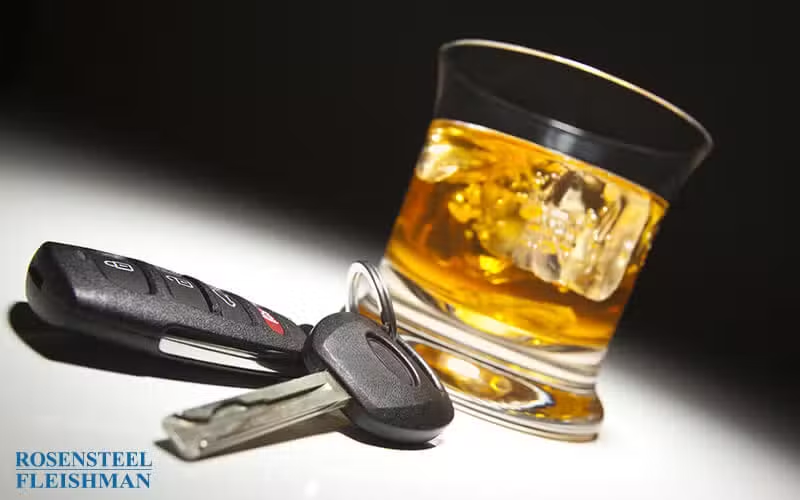

An establishment which serves alcoholic beverages can incur liability for damages resulting from an intoxicated patron driving if an injured party can show that “(1) that the patron was intoxicated and (2) that the licensee or permittee knew or should have known that the patron was in an intoxicated condition at the time he or she was served.” (Hutchens v. Hankins (NC App 1983)) A permittee should have known that the patron was intoxicated if the patron exhibits “outward manifestations of intoxication” such as “bloodshot eyes, thick speech, emotional disturbance, unsteady gait, poor coordination and a strong smell of alcohol.” (Hutchens) North Carolina courts have refused to allow an intoxicated patron to recover for damages caused by their own impaired driving after being served by an establishment. (Sorrells v. M.Y.B. Hospitality Ventures of Asheville (NC SCt 1992))
As part of the Safe Roads Act passed in 1983, North Carolina statute G.S. 18B-305(a) states that “[i]t shall be unlawful for a permittee or his employee or for an ABC store employee to knowingly sell or give alcoholic beverages to any person who is intoxicated.” The first North Carolina case to hold that an injured party could bring a cause of action against an establishment that violated this provision was Hutchens v. Hankins.
In Hutchens, the driver purchased and consumed a large number of beers at the bar over a period of several hours. Fifteen minutes after leaving the bar, he was involved in a head-on collision with the plaintiffs which killed one and severely injured two others. His BAC at the time of the accident was 0.16.
The court of appeals noted in Hutchens that historically, in North Carolina, “it was not a tort to either sell or give intoxicating liquor to ordinary able-bodied men, and no cause of action existed against one furnishing liquor in favor of those injured by the intoxication of the person so furnished.” The rationale behind this was that the proximate cause of the injury was the drinking of the liquor, not the furnishing of it.
However, the court in Hutchens reasoned that “the furnishing of an alcoholic beverage to an intoxicated person may be a proximate cause of injuries inflicted by that individual upon a third person.” The court limited its holding to the context of a vendor of alcoholic beverages who provides drinks to an intoxicated customer and specifically declined to decide whether “a noncommercial furnisher of alcoholic beverages may be subject to civil liability.”
At the time of Hutchens, G.S. 18B-34(a)(2), the predecessor of G.S. 18B-305(a) was in effect which stated that
No holder of a license or permit authorizing the sale at retail of malt beverages or wine (fortified or unfortified) for consumption on or off premises where sold, or any servant, agent or employee of the licensee, shall do any of the following upon the licensed premises… [k]nowingly sell such beverages to any person while such person is in an intoxicated condition.
The court reasoned that the general purposes of the statute were “(1) the protection of the customer from the adverse consequences of intoxication and (2) the protection of the community at large from the possible injurious consequences of contact with an intoxicated person.” Therefore, the court adopted the statutory requirement as the “the minimum standard of conduct for defendant-licensees, and [held] that a violation of this statute can give rise to an action for negligence against the licensee by a member of the public who has been injured by the intoxicated customer.”
The court noted that in order to violate the statute, the licensee/permittee must know that the patron is intoxicated. Relevant to this determination is testimony regarding the patron’s “outward manifestations of intoxication” such as “bloodshot eyes, thick speech, emotional disturbance, unsteady gait, poor coordination and a strong smell of alcohol,” as well as testimony from other patrons or police at the scene of the accident that the patron was "visibly drunk" or "just drunk."
Many cases turn on this issue of whether the permittee knew or should have known that the patron was intoxicated. In the 1998 court of appeals case, Harshbarger v. Murphy, the defendant driver and his friend left work around noon and drank three cans of beer each over a period of three hours. They then went to the defendant night club around 3:00 p.m., where they stay until 5:30 p.m. The defendant driver drank another 6-8 cans of beer at the night club. After leaving the bar, the driver drove his friend home. His friend testified that when they left the night club, the driver did not appear intoxicated and he had no trouble walking, understanding what he said or driving his car. The driver stayed at his friend’s house until 6:50. The accident occurred at 8:42 p.m. The driver testified that he did not remember where he went after leaving his friend’s house and he didn’t remember the accident. When the driver was examined after the accident, his BAC was 0.15. An expert witness estimated his BAC to be 0.18 at the time of the accident and stated that for the driver to have this BAC at 8:42, he would have had to consumer an additional six beers between 6:50 and 8:42.
The court cited Hutchens and stated that to impose civil liability under G.S. 18B-305(a), the plaintiff must show that “(1) that the patron was intoxicated and (2) that the licensee or permittee knew or should have known that the patron was in an intoxicated condition at the time he or she was served.” Because the plaintiff did not introduce any evidence showing that the driver “displayed any manifestations of intoxication or impairment during the time when he was served alcoholic beverages at defendant's night club,” the court of appeals held that the trial court properly granted the defendant night club’s motion for directed verdict.
North Carolina courts have refused to require permittees to take affirmative actions to stop a patron from taking a sip of another customer’s drink and to stop a visibly intoxicated patron from driving. In Hall v. Toreros, II, Inc. (NC App 2006), the driver was at the bar and was served by the only bartender on duty. At about 9:30 p.m., the driver left the bar and went to a grocery store. When the driver came back 30 minutes later, he finished his drink that he had left on the bar and tried to order another but the bartender told him that she had “called last call” when he was out and they were not serving anymore. The driver took a sip from another customer’s drink and asked if he could buy that customer a drink. The bartender repeated that “last call” had been called and they were not serving anymore. The driver left the bar at about 10:30 p.m. Less than a mile away from the bar, the driver was involved in an accident which killed the other driver and seriously injured the passenger.
The jury awarded damages to the plaintiff because the defendant bar failed to “take precautionary measures to prevent [the driver] from operating a motor vehicle when it knew that he was intoxicated” and allowed the driver “to consume an alcoholic beverage on its premises when it knew he was intoxicated.”
The court of appeals affirmed the trial judge’s JNOV and refused to impose a duty upon the bar to prohibit an intoxicated customer from taken even a sip of another customer’s drink on its premises. The court further refused to impose a duty upon the bar from prohibiting the driver from leaving its premises and operating a motor vehicle.
North Carolina courts have also refused to allow an intoxicated driver to recover for his own injuries from a permittee who has violated G.S. 18B-305(a) under the theory of contributory negligence. In the North Carolina Supreme Court case Sorrells v. M.Y.B. Hospitality Ventures of Asheville (1992), the driver was at a bar with his friends and were seated at a table. When the driver arrived, he ordered from the waitress and consumed a shot of tequila. Thereafter, he tried several times to order another drink from the waitress but his friends advised that he was driving and should not be served. At that time, the driver was “highly intoxicated and showed visible signs of impairment.” The driver went to the bathroom and on his way back to the table, stopped at the bar and ordered another drink. The waitress told the manager that she had been advised not to serve the driver but the manager told the bartender to serve him. When the driver finished his drink, he ignored his friends’ offers to find another way home. Instead, he got in his car and ended up crashing his car and dying.
The Court reasoned that the plaintiff could not recover damages because “the allegation that decedent drove his vehicle while impaired established contributory negligence as a matter of law and therefore barred his recovery of damages.” The actions of the bar did not rise to the level of willful and wanton negligence, and instead were the same level of negligence as the driver.
If you have been injured by an impaired driver, contact an attorney at Rosensteel Fleishman Car Accident & Injury Lawyers (704)714-1450, to discuss your options.
Additional Car Accidents Articles
How Soft Tissue Injuries Are Evaluated After a Crash Over Time
The way an injury feels right after a crash is not always the way it will feel several days later. Soft tissue injuries can be frustrating because soreness, stiffness, swelling, headaches, or limited movement may develop slowly, especially after a person has gone home, returned to work, or tried to resume a normal routine around […]
High Impact Crash Overview for Claims With Serious Damage
A serious crash can leave a family trying to make decisions before all the facts are clear. Vehicle damage, medical concerns, missed work, school pickup plans, and insurance calls can all arrive at the same time, which makes it easy for important details to get overlooked. A practical high impact crash overview can help explain […]
How Liability Is Determined in a Car Accident When Reports Are Delayed
Fault decisions often become harder when crash reports, medical records, repair estimates, or insurance updates are delayed. In a Charlotte car accident, even a few missing details can leave drivers unsure about what the insurance company is reviewing, why the claim is taking longer, and what happens when each side tells a different story. A […]