Car crash claims can resolve in different ways depending on the facts, the injuries, the available insurance, and how clearly the evidence supports what happened. For someone trying to understand what to know after a car crash, the resolution process is often less about one single step and more about how each decision affects the […]
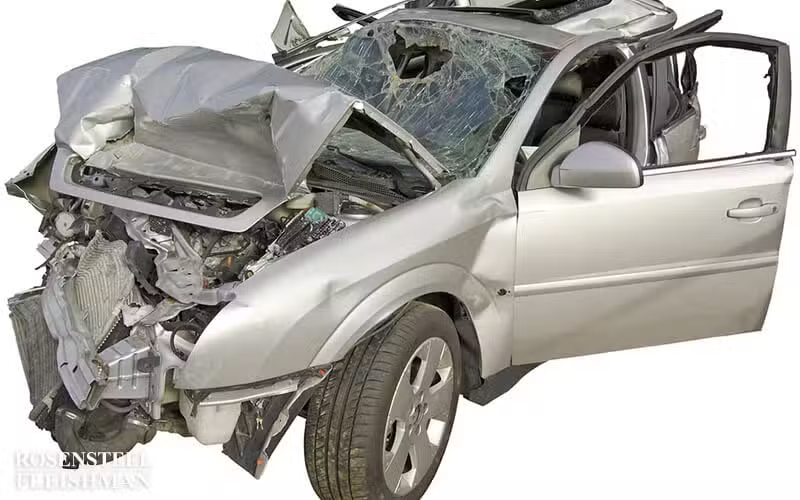

WCNC.com reports that two Catawba County students were killed in a car crash late Friday night. The two boys who died were both fifteen-year-old sophomores. There were also three other people in the car at the time of the accident - two senior girls and a nineteen-year-old man who graduated from high school last spring. The nineteen-year-old was driving. The driver and one of the senior girls were riding in the front seat and wearing their seatbelts. They sustained bruises and broken arms but were quickly released from the hospital. The other girl was riding in the backseat and sustained multiple injuries. She is still in the hospital and is reported to be conscious but suffering from several broken bones. The two boys who died were not wearing their seatbelts and were thrown from the car after it rounded a curve and skidded out of control. A state trooper stated that the initial investigation suggests that the driver was speeding “well above the speed limit” which caused him to lose control of the car around the curve. There is no indication that drugs or alcohol were involved. One of the boys killed in the accident and the girl sitting in the front seat were brother and sister. The car involved in the accident belonged to their mother, according to the state trooper. The news of this accident is devastating, especially considering the ages of the boys who died, but it also brings up a number of issues related to negligence law.
In a negligence claim, a plaintiff must show that he was owed a reasonable duty of care by the defendant, that the defendant breached this duty, that the plaintiff suffered injuries, and that the breach of the duty both actually and proximately caused the plaintiff’s injuries. Negligence per se, however, assumes the failure to exercise reasonable care based on the defendant’s violation of a law which was intended to protect the public. If a defendant is negligent per se, then the plaintiff must prove only the issue of proximate cause.
The North Carolina Supreme Court has explained that
It is the generally accepted view that the violation of a statute enacted for the safety and protection of the public constitutes negligence per se, i. e., negligence as a matter of law. The statute prescribes the standard, and the standard fixed by the statute is absolute. The common law rule of ordinary care does not apply--proof of the breach of the statute is proof of negligence. The violator is liable if injury or damage results, irrespective of how careful or prudent he has been in other respects. No person is at liberty to adopt other methods and precautions which in his opinion are equally or more efficacious to avoid injury. But causal connection between the violation and the injury or damage sustained must be shown; that is to say, proximate cause must be established. In short, where a statute or municipal ordinance imposes upon any person a specific duty for the protection or benefit of others, if he neglects to perform that duty, he is liable to those for whose protection or benefit it was imposed for any injuries or damage of the character which the statute or ordinance was designed to prevent, and which was proximately produced by such neglect, provided the injured party is free from contributory negligence.
Carr v. Murrows Transfer Inc. (1964)
In the case of Friday night’s accident, the news report indicates that the driver was going well above the speed limit. G.S. 20-121(a) contains a general provision that “[n]o person shall drive a vehicle on a highway or in a public vehicular area at a speed greater than is reasonable and prudent under the conditions then existing.” The statute goes on to provide specific speed limits for in and out of municipal corporate limits and also allows municipalities to authorize speed limits on roads other than state highways. Under this statutory provision, operating a vehicle at a speed in excess of the speed limit is unlawful.
Speed limit laws are a perfect example of negligence per se. The speed limit statute was enacted to protect the public. The violation of this law assumes the failure to exercise reasonable care. The driver’s failure to comply with the speed limit caused him to lose control of the car and skid off the road, which caused the boys to be thrown from the car and suffer injuries resulting in their death. Therefore, the driver was negligent.
In North Carolina, a plaintiff also has a duty to act with reasonable care. A plaintiff’s contributory negligence can bar his recovery of damages. North Carolina G.S. 20-135.2A requires that “each occupant of a motor vehicle manufactured with seat belts shall have a seatbelt properly fastened about his or her body at all times when the vehicle is in forward motion on a street or highway in this State.” Does this mean that the boys who were not wearing seatbelts were contributorily negligent and therefore barred from collecting damages?
No, because the statute expressly prohibits evidence of wearing a seatbelt being used to show contributory negligence. Subsection (d) of the statute states that “[e]vidence of failure to wear a seat belt shall not be admissible in any criminal or civil trial, action, or proceeding except in an action based on a violation of this section or as justification for the stop of a vehicle or detention of a vehicle operator and passengers.” Therefore, the boys can not be deemed contributorily negligent because of failure to wear a seatbelt.
Another issue that is often relevant in this type of scenario is the family purpose doctrine. The family purpose doctrine can come up when a teenager is driving a family vehicle owned by his parents. The doctrine is essentially an extension of the theory of agency and allows recovery from the parent owner of the vehicle for the negligence of the teenage driver. To recover damages under the family purpose doctrine, North Carolina courts have held that the injured party must show that:
(1) the operator was a member of the family or household of the owner or person with control and was living in such person's home; (2) that the vehicle was owned, provided and maintained for the general use, pleasure and convenience of the family; and (3) that the vehicle was being so used with the express or implied consent of the owner or person in control at the time of the accident.
However, in this case, the family purpose doctrine is not relevant because the driver was not a family member of the owner. Instead, the injured passengers were family members of the owner. Therefore, the injured passengers cannot hold the owner of the car liable for their injuries under the family purpose doctrine.
Is there any other theory under which to hold the owner of the car liable? The theory of negligent entrustment can be used to hold the owner of a car liable even when that owner is not driving. There are two elements that must be proven to establish negligent entrustment. First, the plaintiff must show that the owner “entrusted” his automobile to the driver. And second, the plaintiff must show that the owner knew or should have known that the driver was likely to cause injury. It is unlikely in the case of Friday night’s accident that the owner entrusted the car to the driver, since the driver was a friend of her children. It is further unlikely that the owner knew that the driver was likely to cause injury. If the owner had entrusted the car to the driver and had known that the driver was especially reckless, an injured passenger might be able to hold the owner liable under the theory of negligent entrustment.
Legal Issues Arising from the Car Accident
The recent car accident in Catawba County, North Carolina raises several legal issues related to negligence. For the families of the victims, it is important to seek the help of a personal injury or car accident lawyer to understand their rights and legal options.
Negligence Claims
In a negligence claim, the plaintiff must prove that the defendant owed a reasonable duty of care, that the defendant breached this duty, that the plaintiff suffered injuries, and that the breach of duty both actually and proximately caused the plaintiff's injuries. However, in some cases, the violation of a safety statute alone can be considered evidence of negligence, known as "negligence per se."
Speed Limit Laws
In the case of the recent car accident, the news report indicates that the driver was speeding, which is a violation of the speed limit law. This violation can be considered evidence of negligence and the families of the victims may be entitled to compensation for their losses.
Seatbelt Laws
North Carolina law prohibits evidence of not wearing a seatbelt from being used as evidence of contributory negligence. This means that the victims who were not wearing seatbelts cannot be barred from collecting damages.
Why Contact a Personal Injury or Car Accident Lawyer
In the aftermath of a tragedy like this, the last thing families want to think about is the legal process. However, seeking the help of a personal injury or car accident lawyer can help the families obtain the compensation they deserve and ensure that their rights are protected. An experienced lawyer can guide the families through the complex process of pursuing a negligence claim and answer any questions they may have.
Additional Car Accidents Articles
Third Party Records in Accidents That May Support a Claim
Clear records from outside sources can make a car accident claim easier to understand, especially when the people involved remember the crash differently or the insurance company asks for more proof. In Charlotte, a routine drive on a busy road can turn into a complicated claim when police reports, medical notes, repair estimates, traffic footage, […]
Highway Accident Overview for Crashes in Charlotte, North Carolina
Highway crashes often move through several stages before anyone has a clear sense of what the claim may become. After a collision on I-77, I-85, I-485, or another busy route in Charlotte, NC, the first concern is always safety and medical care, but the way people communicate afterward can also affect how smoothly the situation […]
Teen Driver Accident Factors Parents Should Understand
As Charlotte continues to grow, more families are seeing teen drivers navigate busier roads, new neighborhoods, school traffic, and changing commute patterns. When a crash happens, the details surrounding what occurred can matter just as much as the damage itself, especially when questions involve a younger driver, incomplete information, and the steps needed to move […]