
Accident recovery rarely follows a perfectly straight path, especially when early symptoms change or new limitations appear after a person returns to normal routines. In Charlotte, someone injured in a collision may begin with goals such as reducing pain, restoring movement, returning to work, or safely resuming everyday activities, then adjust those goals as doctors […]
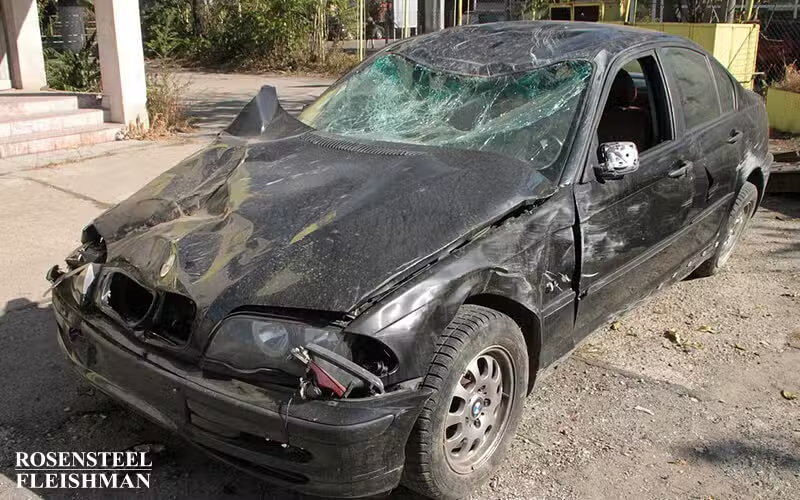

North Carolina continues to apply contributory negligence to ordinary-negligence claims. A claimant’s own negligence can bar recovery when it proximately contributes to the injury. That is different from comparative-fault systems that reduce damages by a percentage, and it makes the exact conduct and causal sequence important.
The question is not merely whether a claimant made a mistake; the defense must connect a lack of due care to the injury through proximate cause.
Start with the two parts of the defense
The North Carolina Court of Appeals explained in Moseley v. Hendricks that a defendant must show a want of due care by the plaintiff and a proximate connection between that negligence and the injury. The Supreme Court’s 2025 decision in Jones v. J. Kim Hatcher Insurance Agencies, Inc. also describes contributory negligence as a bar to recovery from ordinary negligence when the required showing is made.
- Duty the claimant allegedly owed for personal safety, conduct alleged to fall below reasonable care, and source of that duty stated separately
- Time, distance, speed, signal, visibility, lookout, lane position, distraction, impairment, warning, opportunity to react, and claimed alternative action tied to evidence
- Cause of the collision separated from cause of a particular injury, treatment question, or claimed loss
- Disputed fact, inference, witness account, physical evidence, statutory issue, and legal conclusion labeled by source rather than merged
Do not turn every traffic issue into an automatic bar
- Traffic statute or ordinance identified by current section, person protected, conduct required, claimed violation, excuse or dispute, and evidence
- Citation, crash-report field, witness estimate, video, event-data record, roadway mark, photograph, and reconstruction opinion assessed for its permitted purpose
- Alleged speeding, signal violation, unsafe movement, distraction, impairment, or failure to look connected to timing and causation rather than listed as a label
- Defendant negligence and plaintiff contributory negligence analyzed on separate tracks before determining how the doctrines interact
Apply the seat-belt statute as written
G.S. 20-135.2A(d) states that evidence of failure to wear a seat belt is not admissible in a criminal or civil proceeding except for the limited purposes identified in the statute. Seat-belt nonuse should not be treated as a general basis for denying a claim or reducing damages.
- Seat position, applicable belt requirement, claimed nonuse, source, and statutory exception verified before the subject is included in a legal analysis
- Occupant-restraint question separated from the driving conduct that allegedly caused the collision
- Medical mechanism or injury-causation opinion left to qualified evidence and the court’s rulings
- No assumption that an insurer’s assertion, report notation, or photograph makes seat-belt evidence admissible
Treat last clear chance as a demanding separate doctrine
In Culler v. Hamlett, the Court of Appeals addressed contributory negligence and last clear chance. The doctrine requires more than showing that the defendant might have avoided the harm. The record must support the claimant’s peril, discovery or duty to discover it, time and ability to act effectively, a negligent failure to do so, and resulting injury.
- When the claimant entered peril, whether escape remained reasonably available, and when that changed
- What the defendant saw or should have seen, from what viewpoint, under what visibility and attention conditions
- Reaction time, distance, speed, braking, steering, roadway space, vehicle capability, and other means actually available after discovery
- Last clear opportunity separated from a theoretical last possible opportunity reconstructed with hindsight
Keep ordinary negligence and aggravated conduct distinct
The Supreme Court’s decision in Yancey v. Lea discusses gross negligence in a motor-vehicle case and cautions against treating ordinary traffic negligence as aggravated conduct without the required evidence. Whether alleged conduct is willful, wanton, or grossly negligent is a separate legal question; a label such as speeding or leaving the scene does not resolve it by itself.
- Conduct, knowledge, risk, duration, surrounding facts, statutory evidence, and causal connection identified without assuming a mental state
- Ordinary negligence claim, aggravated-conduct claim, punitive-damages question, and contributory-negligence defense kept in separate columns
- Pleading standard, summary-judgment record, jury instruction, and final finding kept separate
- Current controlling authority and the evidence required for the actual claim reviewed before relying on an exception theory
The related guide to stop-sign evidence when contributory negligence is alleged shows how sight lines, stop position, right-of-way, timing, and witness accounts can produce a fact-specific analysis.
Rosensteel Fleishman Car Accident & Injury Lawyers provides general information about North Carolina car-accident claims involving contributory negligence. Fault, causation, defenses, exceptions, evidence, insurance, and deadlines depend on the particular facts and current law.
Sources
Additional Car Accidents Articles
Occupant Safety Considerations in Crashes Involving Unusual Seating Positions
Families often think about crash safety in terms of seat belts, airbags, and where children are seated, but unusual seating positions can change how those protections work. A passenger who is reclined far back, leaning toward the center console, resting their feet on the dashboard, or sitting at an angle may not interact with a […]
Keeping Records After Claim Closure in Case New Issues Develop
After an insurance claim closes, the paperwork connected to the accident can still matter months or even years later. A driver may feel relieved when repairs are completed, medical bills appear resolved, and the insurer marks the file closed, but later developments can make old records important again. Symptoms may return, a medical provider may […]
Insurance Coverage Gaps for Injury Care After Benefits Run Out
A car accident can create medical needs that continue long after the first emergency room visit, particularly when rehabilitation, physical therapy, diagnostic testing, or follow-up treatment stretches across several months. For people recovering in Charlotte, the financial side of that care can become almost as complicated as the treatment itself. Different insurance policies may pay […]


