
Truck crash injuries can affect far more than a person’s ability to work or attend medical appointments. They may also change how someone cooks, cleans, shops, handles yardwork, cares for children, or completes basic home maintenance. Insurers handling claims with several involved parties often examine who caused the collision, which insurance policies apply, and whether […]
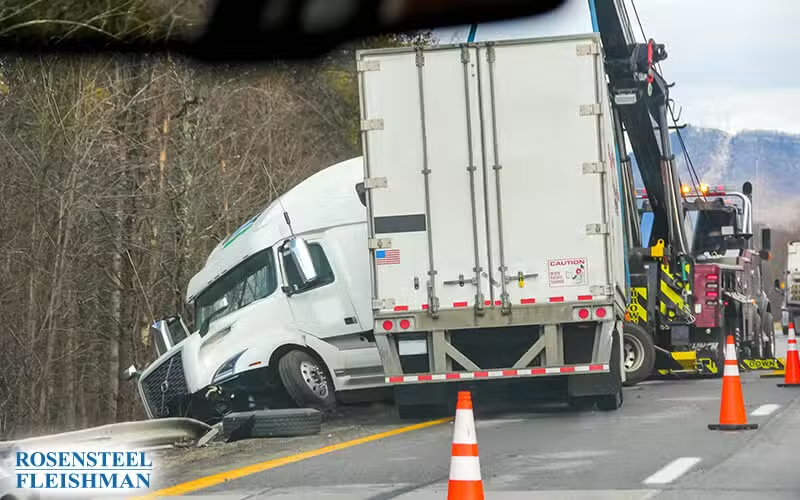

A commercial-truck collision may prompt questions about alcohol or controlled-substance testing. The federal rule does not require a test after every truck crash, and the alcohol and controlled-substance paths have different citation and timing windows. The first task is to identify the driver, vehicle, operation, event outcome, and exact regulatory trigger.
Federal post-accident testing is triggered by the vehicle, operation, event outcome, citation, and timing rules; a serious-looking truck crash does not automatically require both tests.
Confirm that Part 382 applies
49 C.F.R. § 382.107 defines terms used in the federal testing program, including commercial motor vehicle, driver, employer, commerce, disabling damage, and safety-sensitive function. The relevant definition is not determined by the words “truck” or “18 wheeler” in a police report or advertisement.
- Vehicle and combination ratings, actual weights, passenger design, placarding, and cargo
- Driver license class, work role, employer or owner-operator relationship, and safety-sensitive function
- Public-road and commerce facts, trip origin and destination, dispatch, and business purpose
- Fatality, immediate medical treatment away from the scene, disabling damage, tow, and citation timing
- Any exception or separate testing authority identified in the actual record
Apply the post-accident testing table
49 C.F.R. § 382.303 requires testing of identified surviving drivers after a covered occurrence. A human fatality triggers both tests whether or not the driver receives a citation. For bodily injury followed by immediate medical treatment away from the scene, or disabling damage requiring a tow, the rule ties alcohol testing to a qualifying citation within eight hours and controlled-substance testing to a qualifying citation within 32 hours.
The rule contains a table and exceptions that should be read with the definitions. Treatment that begins later, a routine tow, a nonmoving citation, cargo-only damage, or an event outside the rule should not be converted into a trigger without checking the text and facts.
Separate the two collection windows
If a required alcohol test is not administered within two hours, the employer must create and retain a record explaining the delay. Attempts end after eight hours. Attempts to conduct a required controlled-substance test end after 32 hours, with a record explaining why it was not promptly administered. Necessary medical care must not be delayed, and a subject driver must remain readily available subject to the rule’s emergency-care allowance.
Preserve the decision and collection record
49 C.F.R. § 382.401 identifies testing-program records and retention periods. It includes documents generated when deciding whether to administer a post-accident test, collection materials, result records, refusal documents, program administration, and controlled-access requirements.
- The employer’s trigger analysis, incident notice, citation, report, treatment and tow information, and time calculations
- Directions to the driver, availability communications, collection-site records, forms, chain-of-custody material, and laboratory or medical-review records
- Law-enforcement testing records relied on to satisfy the rule and documentation of any unsuccessful attempt
- Native messages, dispatch records, call logs, policies, training receipts, audit history, and record custodians
- The source, timezone, clock accuracy, creation date, later correction, and access history for each record
Do not treat a test result as the complete collision analysis
A required test, a missed test, a positive result, or a negative result does not independently reconstruct speed, lane movement, perception, braking, vehicle condition, cargo, road conditions, or medical causation. Collection timing, test type, laboratory process, medications, law-enforcement observations, alternative explanations, and admissibility all require separate review.
The related truck driver post-crash duties guide covers emergency care, stopping, reporting, vehicle and cargo control, company procedures, and evidence preservation. This page owns the narrower federal testing question.
Rosensteel Fleishman Car Accident & Injury Lawyers provides information about Charlotte truck-accident claims involving a post-crash testing issue. The testing record should be matched to the applicable rule and the complete collision evidence.
Sources
Additional Trucking Accidents Articles
Joint Trauma Truck Collisions Can Cause and How Doctors Confirm It
After a serious truck crash, checking for joint injuries early can reduce the risk of untreated damage becoming harder to manage. The force of a collision may injure cartilage, ligaments, tendons, bones, or the joint capsule even when swelling and pain seem manageable at first. In Charlotte, anyone experiencing stiffness, weakness, instability, or reduced movement […]
Documenting Family Impact Truck Accident Injuries in Charlotte Households
When a serious truck collision disrupts a Charlotte family’s daily life, medical records often become the clearest evidence of what changed and why. Insurance adjusters review those records to determine whether injuries are connected to the crash, how treatment progressed, and whether ongoing limitations are medically supported. That review can affect compensation for medical expenses, […]
How Imaging Confirms Compound Fractures Truck Crash Injuries Can Cause
Compound fractures are medical emergencies that require fast treatment, careful imaging, and thorough documentation. When these injuries result from a collision involving a commercial truck, the medical issues may be clear long before the insurance claim is ready for resolution. Questions about responsibility, insurance coverage, vehicle maintenance, and employment relationships can add months of investigation. […]



