Lane markings, turning movements, and crosswalk locations can help explain a truck collision, but they cannot establish an injury. Clear records help separate crash circumstances from documented losses.
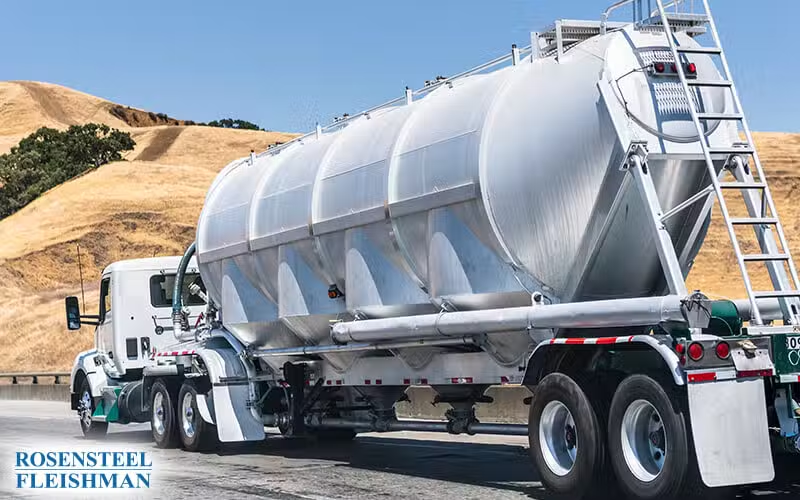

After a commercial-truck crash, people often ask for the “driver file” as though it were one universal folder containing every fact about the driver and collision. Federal rules identify records that a regulated motor carrier must maintain in a driver qualification file, but other safety, employment, vehicle, dispatch, hours, drug-and-alcohol, and crash records may be kept elsewhere.
A driver qualification file is a defined carrier record, not a complete crash file and not automatic proof that a driver or carrier caused a collision.
Confirm that the federal rule applies
Part 391 coverage depends on the carrier, driver, vehicle, operation, commerce, and any exception. Identify the legal motor carrier, USDOT number, operating authority, employer or contractor relationships, vehicle rating and use, route, cargo or passengers, and whether the trip was interstate commerce before treating a federal checklist as controlling.
A local, intrastate, exempt, government, farm, emergency, passenger, or other operation may require a different state or federal analysis. The company shown on a truck door, trailer, bill, lease, insurance card, or electronic log may not be the only entity involved.
The employment application establishes the claimed history
49 C.F.R. § 391.21 requires a signed and completed employment application with identified information, including the applicant’s identity, licensing, experience, accident and violation history, prior employers, and other items specified by the rule. Preserve the original application, supplements, corrections, signature, submission date, and documents used to verify it.
The carrier’s inquiries are distinct from the application
49 C.F.R. § 391.23 addresses required investigations and inquiries into specified driving and safety-performance history. The record should show what was requested, from whom, when, what response arrived, follow-up efforts, the driver’s review or rebuttal if applicable, and how the carrier handled information it learned.
- Motor-vehicle records obtained from the relevant licensing agencies and the exact period each covers
- Safety-performance history requests to prior regulated employers, delivery proof, responses, nonresponses, and documented follow-up
- Crash, violation, license, suspension, revocation, and employment information tied to the correct driver
- Disputed information, driver correction request, prior-employer response, and final file notation
- Date the carrier allowed the driver to operate and what verification was complete at that time
Section 391.51 identifies the qualification-file contents
49 C.F.R. § 391.51 requires each motor carrier within its scope to maintain a qualification file for each employed driver and lists required contents and retention periods. The file may be combined with a personnel file, but the regulation still controls the required records.
- Driver employment application
- Motor-vehicle records and specified investigation material
- Road-test certificate or an accepted equivalent under the applicable rule
- Annual motor-vehicle record and annual review note
- Medical certification and National Registry verification material when required by the current rule
The FMCSA Driver Qualification File Checklist, revised May 2022, is a useful starting inventory. Check its entries against the rules applicable on the relevant date, including later changes to Clearinghouse inquiries and medical-certification records. The checklist is not a current, complete statement of every requirement.
Keep other carrier records in separate evidence tracks
- Hours-of-service and electronic logging data, supporting documents, dispatch, route, fuel, toll, scale, gate, delivery, and communication records
- Drug and alcohol program records, testing decisions, custody documents, Clearinghouse material, and privacy restrictions
- Vehicle inspection, maintenance, repair, defect, roadside inspection, tire, brake, lighting, and out-of-service records
- Accident register, crash report, photographs, video, event data, telematics, cargo, bill of lading, and scene evidence
- Training, policies, supervision, discipline, compensation, scheduling, safety incentives, complaints, and post-crash investigation records
A missing or adverse record needs a causal analysis
An incomplete file can raise a compliance or discovery question, but it does not establish how the collision occurred. Connect any alleged qualification, inquiry, medical, licensing, experience, or review failure to what the carrier knew or should have learned, the driver’s condition or conduct, the crash mechanism, and the claimed injury. Preserve competing explanations and the dates each fact became known.
Request the file by correct custodian and date range
Identify the motor carrier and any leasing, staffing, owner-operator, affiliate, or records vendor. A preservation request should describe the driver, vehicle, trip, collision, regulatory and employment records, electronic systems, and relevant time. Protect confidential medical, licensing, employment, and drug-testing material through proportionate procedures rather than public disclosure.
The related motor-carrier identification guide explains USDOT records, operating authority, leases, bills of lading, dispatch, insurance, and company roles.
Rosensteel Fleishman Car Accident & Injury Lawyers provides information about a Charlotte truck-accident claim involving driver qualification records. The review should confirm regulatory scope, the proper carrier and driver, required file contents, retention, other evidence systems, and the connection to the actual crash.
Sources
Additional Trucking Accidents Articles
Living With Permanent Disabilities After a Truck Crash Involving Multiple Vehicles
A lasting disability affects more than a claim file. Learn how to connect the collision timeline with documented changes in work, household responsibilities, and expenses without treating assumptions as evidence.
Reducing Reinjury Risk With Physical Therapy After a Truck Crash in Charlotte
Concerns about reinjury involve medical questions that claim records cannot answer. Learn how to organize physical therapy documentation, practical expenses, and scene evidence without drawing unsupported conclusions.
When Mobility Loss After a Charlotte, NC Truck Crash Has No Clear Diagnosis
An unclear diagnosis does not prevent a family from recording practical changes after a truck crash. Keep observations, added expenses, and unanswered claim questions separate.