
Work disruptions after a bicycle injury can involve more than missed paychecks. Separating employment support expenses, lost income, and future earning concerns helps make the financial picture clearer.
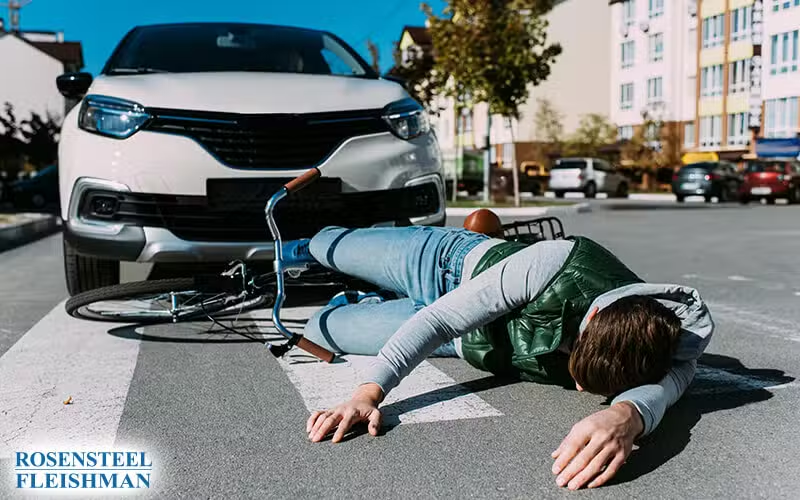

A close pass can force a person on a bicycle toward a curb, shoulder defect, parked vehicle, drainage grate, or traffic lane even when the overtaking vehicle never makes direct contact. The legal analysis depends on which passing rule applied and how the complete maneuver occurred.
North Carolina has a general two-foot overtaking rule and a separate four-foot condition for a limited pass in a marked no-passing zone; they should not be merged into one slogan.
Start with the general overtaking rule
G.S. 20-149(a) requires a driver overtaking another vehicle proceeding in the same direction to pass at least two feet to the left and not return to the right side of the highway until safely clear. The statute identifies exceptions when the pass is performed under G.S. 20-150(e) or G.S. 20-150.1.
The measured distance is only one part of the maneuver. Vehicle width, mirrors, trailer tracking, speed difference, wind effect, lane position, road edge, bicycle movement, and the point at which the driver returned right can all matter to whether the pass was completed safely.
The four-foot provision applies to a specific no-passing-zone exception
G.S. 20-150(e) generally prohibits passing on a highway marked to indicate that passing should not be attempted. It then creates an exception when all listed conditions are satisfied: the slower vehicle is a bicycle or moped traveling in the same direction, the faster vehicle provides at least four feet or completely enters the left lane, the slower operator is not making or signaling a left turn, and the faster driver complies with the other applicable requirements of the section.
That exception does not turn four feet into permission to pass anywhere. The same statute addresses oncoming traffic, obstructed views at grades and curves, railway crossings, designated intersections, visible centerlines, and other limitations. A driver should wait when the maneuver cannot be completed safely.
Determine whether the cyclist was preparing to turn left
- Cyclist lane position, shoulder or bike-lane exit, head check, hand signal, speed change, and approach to the turn
- Driver view, following distance, horn or other warning, acceleration, steering, and decision point
- Intersection, driveway, median opening, trail access, lane markings, sign, centerline, and sight distance
- Whether the cyclist’s movement preceded the pass, responded to the pass, or occurred after the vehicle was alongside
- Accounts from each participant and witness kept separate from later assumptions about intent
Preserve distance and timing evidence
- Original dashcam, helmet camera, bicycle camera, traffic camera, business video, doorbell video, and bystander files
- Vehicle damage, mirror and trailer dimensions, bicycle damage, wheel and handlebar alignment, clothing, and personal equipment
- Road width, lane and shoulder width, curb and edge condition, grade, curve, markings, signs, parked vehicles, weather, and lighting
- Vehicle event, telematics, navigation, driver-assistance, and phone evidence collected through lawful and technically sound methods
- Cycling-computer, GPS, radar, light, phone, and wearable data with clock settings, source files, and accuracy limits
A statutory issue does not prove the entire claim
A citation, measured clearance, or no-passing marking may be relevant, but an injury claim still requires proof of conduct, causation, injury, damages, and responses to asserted defenses. A noncontact fall may require careful reconstruction of when and why the cyclist changed direction. A contact crash may require comparison of damage, trajectory, and medical findings.
Do not alter or test the bicycle, helmet, vehicle, camera, or electronic data without documenting custody and considering whether another interested party needs a reasonable inspection opportunity. Preserve the original item and create working copies for analysis.
The related North Carolina bicycle-accident liability guide explains driver and cyclist conduct, contributory negligence, causation, and responsible-party analysis. This page owns the narrower overtaking and clearance question.
Rosensteel Fleishman Car Accident & Injury Lawyers provides information about a Charlotte bicycle-accident claim involving a close or unsafe pass. A review should match the exact roadway, markings, sight distance, movements, clearance, and preserved source evidence to the applicable rule.
Sources
Additional Bicycle Accidents Articles
How Insurers Evaluate Extra Work Breaks During Bicycle Injury Recovery
Extra breaks can change a workday without changing a paycheck. Clear records help distinguish interrupted tasks, unpaid time, and questions about responsibility for a bicycle accident.
Charlotte Street Lighting and Light Sensitivity After a Bicycle Injury
Street lighting at a crash scene and light sensitivity afterward raise different documentation questions. Clear records can help explain what happened, what changed, and what still needs legal review.
Using Bicycle Injury Recovery Reviews to Identify Lasting Limitations
Bicycle injury progress reviews can document continuing difficulties without proving that a limitation is permanent. Learn what to record and how to address conflicting accounts.



