A motorcycle crash should be reported promptly to law enforcement and the appropriate insurance companies, even when pain or numbness seems minor at first. Nerve symptoms may develop gradually, and a timely report creates an official record connecting the incident to the circumstances in which the injury occurred. Missing a reporting deadline or giving incomplete […]
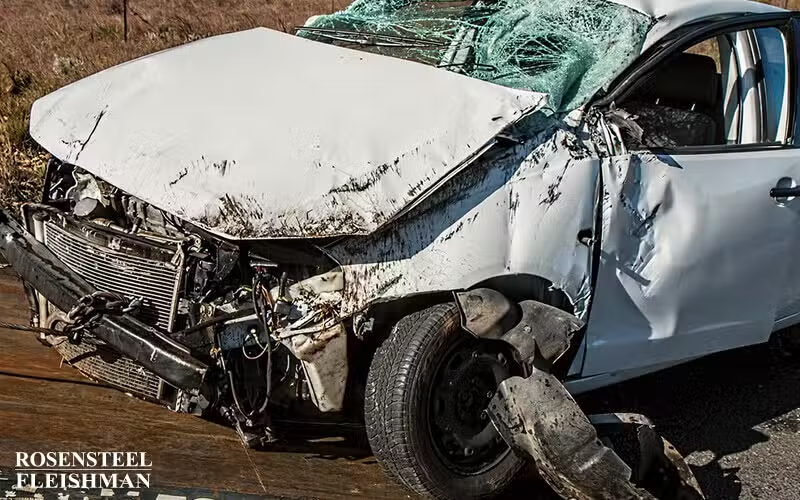

A driver who encounters an unexpected hazard may argue that there was too little time to respond normally. North Carolina’s sudden-emergency doctrine can affect how reasonable care is evaluated, but the phrase is not a complete defense merely because a collision happened quickly.
The doctrine evaluates conduct after a genuinely sudden emergency arises; it does not excuse negligence that helped create the emergency. The event, the driver’s perception, and the available response must be examined in sequence.
The driver must perceive and respond to an emergency
The official appellate report containing Goins v. Time Warner Cable Southeast, LLC explains that the doctrine concerns a person confronted with sudden danger who acts as a reasonably prudent person might under the same conditions. The court emphasized that the doctrine applies to conduct after the emergency arises and requires evidence that the person perceived and reacted to it.
That focus prevents an unexplained loss of control from being relabeled as an emergency. The evidence should identify what suddenly changed, when the driver noticed it, which choices remained, and what the driver actually did.
A driver cannot rely on an emergency the driver helped create
Goins also explains that a person whose negligence contributed to creating the emergency cannot use the doctrine to avoid the ordinary consequences of that negligence. Excessive speed, inattention, following too closely, unsafe equipment, or ignoring known conditions may therefore matter before the claimed emergency began.
G.S. 20-141 requires a speed that is reasonable and prudent under existing conditions and specifically addresses hazards including weather, road conditions, intersections, curves, hills, pedestrians, and other traffic. Compliance with a posted maximum does not necessarily resolve whether the speed was safe for the actual conditions.
Reckless driving and sudden emergency are different questions
G.S. 20-140 addresses driving carelessly and heedlessly in willful or wanton disregard of others and driving without due caution at a speed or in a manner likely to endanger a person or property. A citation decision under that criminal statute and civil evaluation of a sudden-emergency argument serve different purposes.
No citation does not establish that the driver acted reasonably, and a citation does not by itself decide civil liability. The underlying conduct and causal relationship remain important.
Common claimed emergencies require fact-specific proof
- A vehicle, pedestrian, animal, or object that entered the travel lane unexpectedly
- A mechanical failure, tire failure, or medical event and whether warning signs existed
- Ice, standing water, fog, glare, smoke, or debris and whether the condition was visible or forecast
- Another driver’s sudden stop, lane change, or wrong-way movement and the following distance available
- A signal outage, road work, missing warning, or sight obstruction and what approaching drivers could observe
The related analysis of black ice, reasonable speed, and sudden-emergency evidence shows why a condition can be unexpected to one driver but foreseeable to another. Weather, road notice, speed, and perception evidence must be evaluated together.
Evidence should reconstruct the available time and choices
- Dash-camera, business, traffic, residential, and vehicle video
- Event-data, braking, steering, speed, phone, and infotainment records when available
- Scene photographs, weather observations, sight distances, road geometry, lighting, and warning signs
- Vehicle inspection and maintenance records for a claimed equipment failure
- Witness descriptions of the hazard, the driver’s response, and statements made after the collision
- Crash-reconstruction analysis separating pre-emergency conduct from the reaction after perception
The doctrine does not replace the complete liability analysis
A sudden-emergency issue can affect the conduct of a defendant, plaintiff, or another involved driver. North Carolina contributory-negligence and proximate-cause rules may also affect the result, so the complete sequence and every contributing actor should be considered.
Rosensteel Fleishman Car Accident & Injury Lawyers provides information about car-accident claims in Charlotte. A collision involving an asserted emergency requires prompt preservation of vehicle data, video, physical evidence, witness information, medical evidence, insurance information, and applicable deadlines.
Sources
Additional Personal Injury Articles
How Treatment Justification Affects an Injury Claim and the Review Process
Charlotte’s continued growth means more vehicles, changing traffic patterns, construction activity, and daily travel across busy roads, which can also create more situations where people are hurt in crashes or other unexpected incidents. When an injury claim follows, the insurance company may look closely at not only what happened but also whether the medical treatment […]
How Counteroffers Work in Car Accident Settlements When New Evidence Emerges
For families in Charlotte, North Carolina, the weeks after a car accident can bring new information that was not available when an insurance claim first began. Follow-up medical appointments may reveal that an injury is taking longer to heal than expected, additional treatment may become necessary, or a doctor may identify limitations that were not […]
Planning Skills After Fall Recovery and Returning to Everyday Responsibilities
Rebuilding a dependable routine after a fall often happens one responsibility at a time. Even an injury that initially appears minor may continue affecting concentration, stamina, mobility, or confidence, which can make ordinary planning more difficult. Charlotte residents facing these challenges may also need to organize records, manage missed work, and understand whether speaking with […]