
Responsible recordkeeping after a crash means separating observations from assumptions. Learn what to document about assistance, follow-up appointments, and practical disruptions.
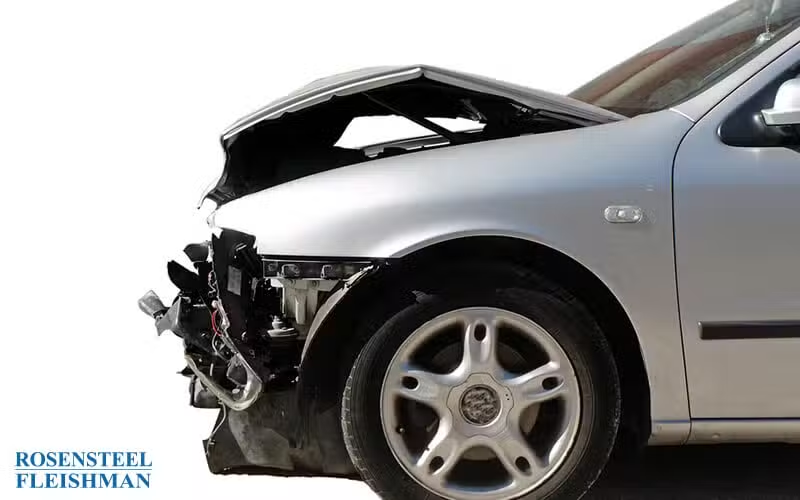

A collision involving a learner’s-permit driver can raise several separate questions: whether the permit holder drove negligently, whether an adult qualified and acted as the required supervising driver, whether that person had a reasonable opportunity to prevent or correct the conduct, who controlled the vehicle, and which insurance applies. Relationship or presence in the front seat does not answer every question.
A supervising adult is not automatically liable for every mistake by a permit holder; the opportunity and failure to exercise supervision must be proved from the sequence.
Confirm the permit and supervision rules in effect
North Carolina General Statute 20-11 establishes graduated driving privileges for people under 18. Current Level 1 restrictions include possession of the permit and a supervising driver seated beside the permit holder in the front seat while the vehicle is moving. Subsection (k) defines a supervising driver and requires, among other things, a qualifying relationship or approval and at least five years of licensure.
- Obtain the permit or license record, issue date, level, restrictions, driving log, application, and identity of each approved supervising driver
- Confirm the supervising adult’s license status, seating position, relationship or approval, and attention at the time
- Document time, passengers, seat-belt use, phone use, roadway or parking-area status, and every restriction that actually applied
- Preserve vehicle controls, camera footage, event data, scene measurements, witness accounts, and contemporaneous statements before conditions change
Separate the permit holder’s driving from the adult’s supervision
The driver’s speed, lookout, steering, braking, gear selection, lane movement, right of way, and response must be evaluated first. A citation decision does not decide the civil claim, and lack of a citation does not establish reasonable care.
The supervising adult’s conduct is a different inquiry. Relevant evidence can include prior warnings, instructions given, the permit holder’s experience, known difficulty with the maneuver, visibility of the hazard, access to controls, distractions, speed of events, and the time available to warn or intervene.
Stanfield focuses on opportunity to exercise control
In Stanfield v. Tilghman, reported in volume 342 of the North Carolina Reports, the Supreme Court addressed whether a permit holder’s negligence was imputed to the mother supervising him. The Court explained that the supervising person’s right and duty to control must be paired with a reasonable opportunity to exercise it and a failure to do so. On the record viewed for the plaintiff, the driver’s sudden movement supported a jury question rather than automatic imputation.
A slow parking maneuver, repeated error, known inexperience, warning ignored over time, or visible approach to a hazard may present different evidence from a split-second departure from the roadway. The decision supplies an analytical sequence, not a preset result for a parent or other supervisor.
Evaluate vehicle-based responsibility separately
The registered owner, purchaser, person making payments, insurer, person holding the keys, person arranging maintenance, household use, and permission can matter to additional theories. Those facts should not be assumed from the permit holder’s age or the adult’s presence.
The related guide to the family purpose doctrine in North Carolina addresses whether a person who furnished and controlled a vehicle for family use may face imputed liability. That doctrine and negligent supervision can use overlapping evidence but require separate findings.
Build an evidence map for every possible source of recovery
- List the permit holder, supervising driver, registered owner, vehicle controller, household members, employer, and each insurer separately
- Create a second-by-second sequence of instructions, perception, vehicle movement, warning, attempted correction, impact, and post-crash statements
- Preserve the policy, declarations, endorsements, permissive-use facts, household disclosures, exclusions, and claim communications
- Document each injured person’s location, mechanism, medical evaluation, diagnosis, treatment, recovery, expenses, work effect, and other claimed loss
Rosensteel Fleishman Car Accident & Injury Lawyers provides general information about speaking with a Charlotte car-accident lawyer after a learner’s-permit driver causes a collision. Driver negligence, supervision, vehicle control, family purpose, insurance, causation, damages, defenses, and deadlines depend on the evidence and current law.
Sources
Additional Car Accidents Articles
How Scene Safety Affects Charlotte Crash Documentation and Claims
Safety can limit what you document after a crash. Clear notes about timing, vehicle spacing, and scene changes help explain those limits without guessing about fault.
When an Older Driver’s Medical Condition Affects Crash Liability and Costs
A medical condition alone does not explain a crash. Connecting records to the collision and tracking bills that have not arrived helps keep fault questions separate from unresolved costs.
Overlooked Factors in Charlotte Car Accident Settlement Evaluations
A settlement evaluation involves more than adding bills. Clear records can help explain household disruption, work losses, disputed expenses, and why an offer changes as information develops.



